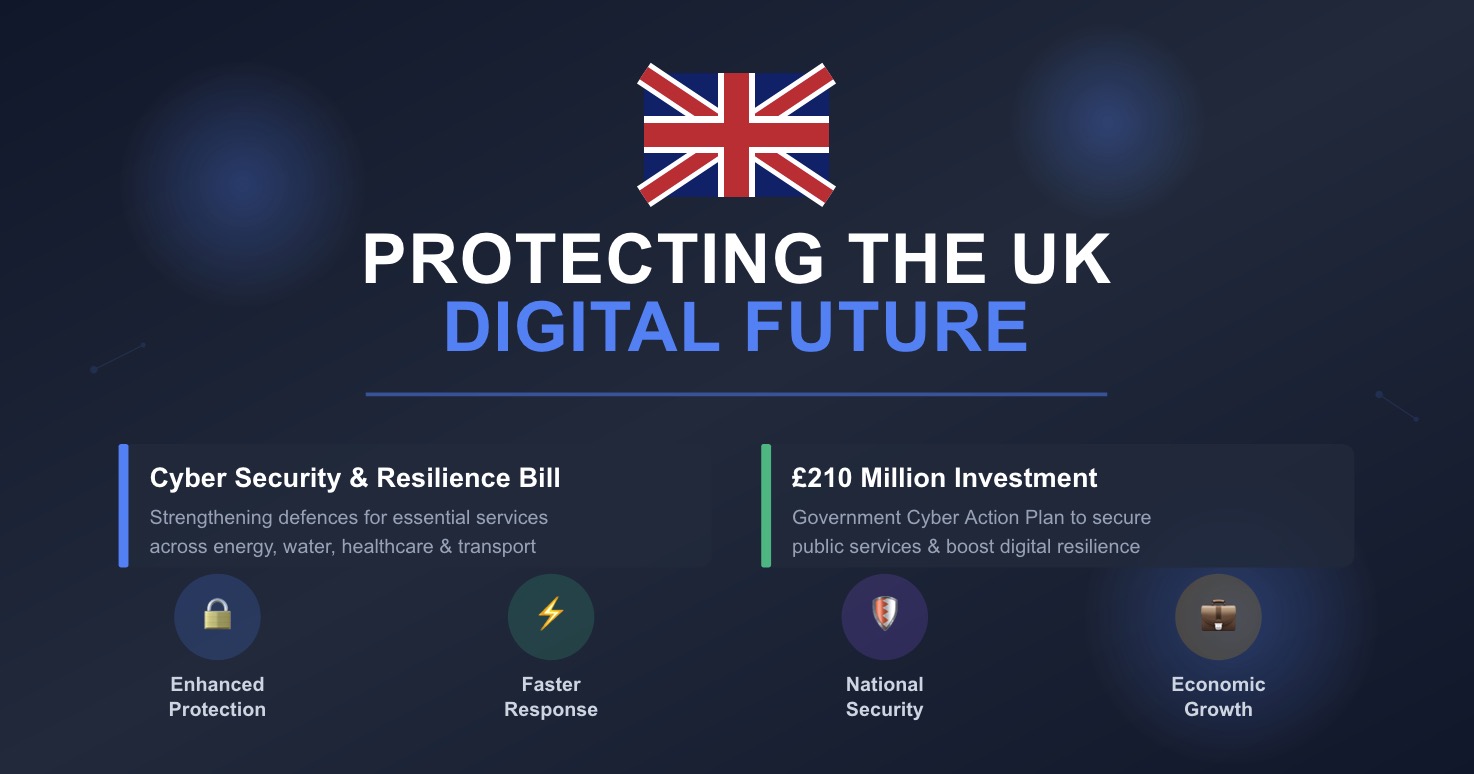
The UK government is taking bold steps to protect our digital infrastructure from cyber threats. Two major initiatives: the Cyber Security and Resilience Bill and the Government Cyber Action Plan are working together to create a safer digital future for everyone.
Why This Matters to You?
Cyber attacks aren’t just technical problems, they affect real lives. When cyber criminals strike, vital public services can go offline in minutes, disrupting daily life and eroding public confidence. Whether you’re switching on lights, accessing safe water, using NHS services, paying taxes, or applying for benefits, you rely on digital systems that need robust protection.
The Cyber Security and Resilience Bill: Stronger Defences for Essential Services
Introduced to Parliament in November 2025, this legislation will strengthen UK defences against cyber attacks and better protect services that the public relies on. It builds on existing regulations to create more comprehensive protection.
What the Bill covers?
The legislation focuses on essential and digital services across multiple sectors. Energy providers, water companies, healthcare services, transport networks, and data centres will all need to meet higher security standards. This means the organisations that keep our country running will have clear requirements to defend against cyber criminals and hostile state actors.
The benefits:
The Bill aims to enhance national security fundamentally while supporting economic stability. Better cyber defences reduce business costs and disruption while encouraging investment, helping grow the economy for working people. When businesses aren’t dealing with costly breaches and downtime, they can focus on innovation and growth.
The Government Cyber Action Plan: Securing Public Services
Released in January 2026 alongside a £210 million investment, this plan specifically targets cyber resilience across government departments and public services. It’s about making sure the digital services you use, from benefit applications to healthcare portals are secure and reliable.
The plan creates
A new Government Cyber Unit will coordinate risk management across all departments, ensuring consistent and effective responses to threats. This central team will tackle complex challenges that individual departments can’t solve alone, bringing expertise and resources where they’re needed most.
Four key improvements:
- The plan delivers clearer understanding of risks throughout government, identifying vulnerabilities before they can be exploited.
- Strong central coordination will address the most severe threats with joined up action across departments.
- Faster response capabilities mean quicker reactions to emerging dangers, minimising harm and speeding recovery.
- Finally, targeted measures will boost resilience across the board, protecting critical services at scale.
Why digital services need this protection
The government is working to digitise more public services, making them accessible online and reducing paperwork and phone queues. This digital transformation could unlock up to £45 billion in productivity savings across the public sector. However, these benefits only work if people trust the systems. The Action Plan ensures that as services move online, they remain secure and resilient.
Making Software More Secure
Beyond government systems, the new Software Security Ambassador Scheme tackles a growing concern: software supply chain attacks. Major companies including Cisco, Palo Alto Networks, Sage, Santander, and NCC Group are leading the charge to improve basic security practices across the software industry with companies such as runZero, are helping with total exposure management and hollistic visiblity across IT, OT and IoT environments .
Software forms the backbone of all technologies that businesses depend on, yet more than half of organisations have experienced software supply chain attacks in the past year. By establishing better security standards from the start, these problems can be prevented before they cause disruption.
What This Means for Businesses
If your organisation provides essential services or works with government departments, you’ll need to strengthen your cyber defences. While this might seem daunting, it ultimately protects your business from costly disruptions and builds customer trust.
The Bill sets clear expectations, giving you a roadmap for compliance rather than leaving you guessing about requirements. Investment in cybersecurity now prevents far more expensive problems later, both in direct costs and reputation damage.
What This Means for Citizens
You can expect more secure access to online public services with greater confidence that your personal data is protected. When incidents do occur, faster government response times will minimise disruption to essential services like healthcare, utilities, and benefits.
As digital services expand, you’ll enjoy more convenience without sacrificing security. The goal is simple: making government services work better for you while keeping your information safe.
Looking Ahead
These initiatives represent a fundamental shift in how the UK approaches cyber security. Rather than reacting to threats as they emerge, the government is building resilient systems from the ground up.
The plan sets new standards to strengthen public sector defences, sending a clear warning to cyber criminals that the UK is moving faster and more decisively to protect businesses and public services.
As our world becomes increasingly digital, cyber security isn’t just a technical issue, it’s essential infrastructure that underpins our economy, national security, and daily life. These new measures ensure that the UK’s digital foundations are strong enough to support the services and prosperity we all depend on.
the Cyber Security and Resilience Bill and the Government Cyber Action Plan are working together to create a safer digital future for everyone. Here’s what you need to know.
Why This Matters to You?
Cyber attacks aren’t just technical problems, they affect real lives. When cyber criminals strike, vital public services can go offline in minutes, disrupting daily life and eroding public confidence. Whether you’re switching on lights, accessing safe water, using NHS services, paying taxes, or applying for benefits, you rely on digital systems that need robust protection.
The Cyber Security and Resilience Bill: Stronger Defences for Essential Services
Introduced to Parliament in November 2025, this legislation will strengthen UK defences against cyber attacks and better protect services that the public relies on. It builds on existing regulations to create more comprehensive protection.
What the Bill covers:
The legislation focuses on essential and digital services across multiple sectors. Energy providers, water companies, healthcare services, transport networks, and data centres will all need to meet higher security standards. This means the organisations that keep our country running will have clear requirements to defend against cyber criminals and hostile state actors.
The benefits:
The Bill aims to enhance national security fundamentally while supporting economic stability. Better cyber defences reduce business costs and disruption while encouraging investment, helping grow the economy for working people. When businesses aren’t dealing with costly breaches and downtime, they can focus on innovation and growth.
The Government Cyber Action Plan: Securing Public Services
Released in January 2026 alongside a £210 million investment, this plan specifically targets cyber resilience across government departments and public services. It’s about making sure the digital services you use, from benefit applications to healthcare portals are secure and reliable.
The plan creates:
A new Government Cyber Unit will coordinate risk management across all departments, ensuring consistent and effective responses to threats. This central team will tackle complex challenges that individual departments can’t solve alone, bringing expertise and resources where they’re needed most.
Four key improvements:
The plan delivers clearer understanding of risks throughout government, identifying vulnerabilities before they can be exploited. Strong central coordination will address the most severe threats with joined, up action across departments. Faster response capabilities mean quicker reactions to emerging dangers, minimising harm and speeding recovery. Finally, targeted measures will boost resilience across the board, protecting critical services at scale.
Why digital services need this protection:
The government is working to digitise more public services, making them accessible online and reducing paperwork and phone queues. This digital transformation could unlock up to £45 billion in productivity savings across the public sector. However, these benefits only work if people trust the systems. The Action Plan ensures that as services move online, they remain secure and resilient.
Making Software More Secure
Beyond government systems, the new Software Security Ambassador Scheme tackles a growing concern: software supply chain attacks. Major companies including Cisco, Palo Alto Networks, Sage, Santander, and NCC Group are leading the charge to improve basic security practices across the software industry.
Software forms the backbone of all technologies that businesses depend on, yet more than half of organisations have experienced software supply chain attacks in the past year. By establishing better security standards from the start, these problems can be prevented before they cause disruption.
What This Means for Businesses
If your organisation provides essential services or works with government departments, you’ll need to strengthen your cyber defences. While this might seem daunting, it ultimately protects your business from costly disruptions and builds customer trust.
The Bill sets clear expectations, giving you a roadmap for compliance rather than leaving you guessing about requirements. Investment in cybersecurity now prevents far more expensive problems later, both in direct costs and reputation damage.
What This Means for Citizens
You can expect more secure access to online public services with greater confidence that your personal data is protected. When incidents do occur, faster government response times will minimise disruption to essential services like healthcare, utilities, and benefits.
As digital services expand, you’ll enjoy more convenience without sacrificing security. The goal is simple: making government services work better for you while keeping your information safe.
Looking Ahead
These initiatives represent a fundamental shift in how the UK approaches cyber security. Rather than reacting to threats as they emerge, the government is building resilient systems from the ground up.
The plan sets new standards to strengthen public sector defences, sending a clear warning to cyber criminals that the UK is moving faster and more decisively to protect businesses and public services.
As our world becomes increasingly digital, cyber security isn’t just a technical issue, it’s essential infrastructure that underpins our economy, national security, and daily life. These new measures ensure that the UK’s digital foundations are strong enough to support the services and prosperity we all depend on.
Sources:
– https://www.gov.uk/government/collections/cyber-security-and-resilience-bill